
I recommend FancyDove AI Assistant for portable tutoring, translation and offline ChatGPT, AI VoiceWriter for hands‑free dictation and real‑time editing across Word, Docs and Teams, and Vision1 Mini Offline AI USB Drive for privacy‑first, local AI on any PC. All three work without subscriptions and offer one‑time purchases, so you can boost content quality anywhere. They each support multiple languages and integrate smoothly with your workflow, and if you keep going you’ll see how to pick the best fit.
FancyDove AI Assistant – Portable ChatGPT Tutor, Translator
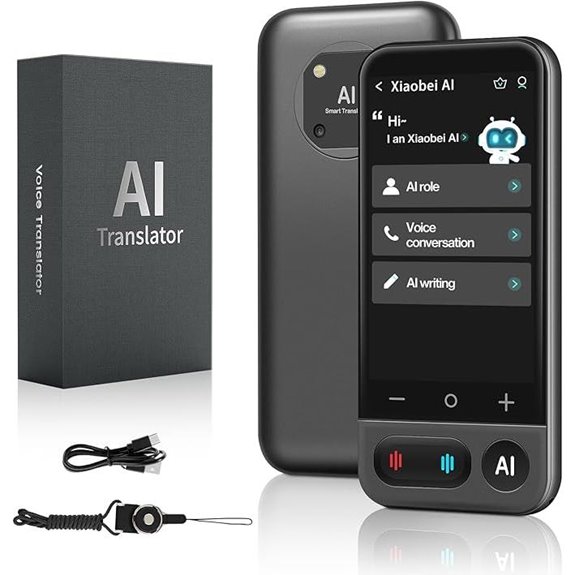
If you need a portable AI tutor that can also translate on the fly, FancyDove AI Assistant fits the bill. I use it daily for writing and language practice. It’s a pocket‑sized device that runs ChatGPT offline, so I never need a subscription. I can switch it to tutor, writing coach, or travel guide with a single tap. The translator handles 149 languages, voice and image input, and corrects my pronunciation in real time. The battery lasts all day, and the simple interface works for anyone, from kids to seniors. I carry it in my bag, and it never gets in the way.
AI VoiceWriter – Smart Dictation & Writing Assistant
https://m.media-amazon.com/images/I/71AMYuYfIJL._AC_SX679_.jpg
AI VoiceWriter is perfect for anyone who wants hands‑free typing without learning new software. I plug the tiny USB dongle into my PC, install the mobile app, and start speaking. It captures my words in real time and types them into Word, Docs, PowerPoint, Teams, or any text field. I can proofread, rephrase, and format emails or reports with a single command. The tool supports 33 languages, so I switch between English, French, Japanese, and more without hassle. It works on Windows 10+, macOS 13+, iOS 15+, and Android 9+. No subscription—just a one‑time purchase and lifetime updates.
Vision1 Mini Offline AI USB Drive – Portable Local AI Assistant
https://m.media-amazon.com/images/I/31XjFc6fP9L._AC_.jpg
Who needs a writing assistant that never connects to the internet? I plug the Vision1 Mini into my 64‑bit PC and it runs entirely offline. All data stays on my computer, so privacy is guaranteed. No accounts, no cloud, no fees. It supports over a languages, so I can switch between English and Spanish without hassle. The device adapts to my hardware, so performance feels smooth. I use it for natural conversation, document analysis, and writing help. It’s a one‑time purchase, no subscriptions. Just plug, open, and start working.
Factors to Consider When Choosing AI Writing Assistants
I’ll walk you through the key factors to weigh when picking an AI writing assistant. Think about how clear the pricing model is, which languages it supports, and whether it runs offline or in the cloud. Also check how well it integrates with your current tools and if you can shape its persona to match your style.
Pricing Model Transparency
So, what should you look for when a tool’s price tag is laid out? I check if the model is a one‑time purchase or a subscription. A one‑time fee means I won’t face recurring costs, but I need to know if updates are free. I also read the fine print for hidden fees—regional taxes, shipping for any hardware, or license restrictions. Clear limits on features or usage caps matter; I want to know exactly what I’m paying for. I look for disclosed free‑trial periods and money‑back guarantees, because they reduce risk. Finally, I verify upgrade paths. If a higher tier costs extra, I need that cost spelled out now, not later. This transparency lets me compare value without surprises.
Language Support Breadth
What matters most is how many languages the assistant actually handles. I look for a tool that covers the big global tongues and also niche dialects. If it can spot grammar errors in Spanish, French, Mandarin, and Swahili, that’s a good sign. I need it to adapt style and idioms, not just translate word‑for‑word. Real‑time translation and pronunciation tips help when I write across languages. Cross‑language drafting lets me start in English and finish in German without losing tone. I check that the service updates its language models regularly, because usage evolve. A broad, well‑maintained language suite keeps my content accurate and relevant.
Offline vs Cloud Operation
Ever wonder if you need internet to write? I’ve tried both offline and cloud AI assistants, and each has trade‑offs. Offline keeps everything on my device, so my drafts never leave my computer. That protects privacy and avoids any subscription login. I don’t worry about server outages or a spotty Wi‑Fi cutting me off. The downside is I need a decent CPU or GPU and enough storage for the model. Updates are rare, so I miss new features until I reinstall a newer version. Cloud assistants run on powerful servers, so they feel faster and get fresh improvements automatically. But they require an internet connection, send data to the cloud, and can be unavailable if the service goes down. Choose based on how much privacy, reliability, and hardware you’re comfortable with.
Integration With Existing Tools
I’ve already weighed the pros and cons of offline versus cloud AI assistants, and now I’m looking at how they fit into the tools I already use. I check whether the assistant plugs into Word, Google Docs, or my email client. If it needs a separate app, I verify it works on my OS and on my phone. Real‑time collaboration matters, so I look for plug‑ins that let teammates comment and see version history. Export options are a must; I need DOCX, PDF, and plain‑text without losing formatting. Finally, I make sure the assistant can call my templates, macros, and style guides so my writing stays consistent across projects.
Customizable AI Personas
How much does a persona shape the way you write? I’ve found that a custom AI persona can change my whole workflow. I can set the model to act as a tutor, a writing assistant, a language coach, or even a travel guide. By defining goals, tone, and teaching style, I get consistent feedback across sessions. I can tweak the persona to focus on grammar, style, or subject‑specific explanations. Real‑time feedback adapts too—pronunciation correction or step‑by‑step problem solving match my preferences. Managing several personas lets me switch from student to professional writer to traveler without opening new tools or accounts. This flexibility keeps my work on track and saves time.
Data Privacy Guarantees
Do you know what really protects your drafts? I look for offline or local processing. When the app never syncs to the cloud, my text stays on my device. I also avoid tools that require accounts. No login means no usage history that a server could collect. I prefer a one‑time purchase. Subscription services often trade data for revenue. Clear privacy guarantees matter. I read the fine print to see if any data is used for model improvement, stored locally, or erased after use. Multilingual offline features help me keep sensitive content private when I need translation or proofreading. These factors let me trust the assistant without worrying about hidden data collection.
Real‑Time Collaboration Features
When you work with a team, real‑time collaboration is a must. I look for simultaneous editing so everyone can type at once. Live cursors let me see who’s writing where, and I never lose track of changes. Presence indicators tell me who’s active, so I can ask a quick question without guessing. In‑app chat or comment threads tied to a paragraph let me give feedback right where it belongs. Change tracking and version history let me compare revisions and roll back if needed. Access controls let me set who can edit, comment, or just view, keeping the document safe. These features keep the workflow smooth and avoid version conflicts.
Be the first to comment on "3 Top AI Writing Assistants That Boost Your Content Game"