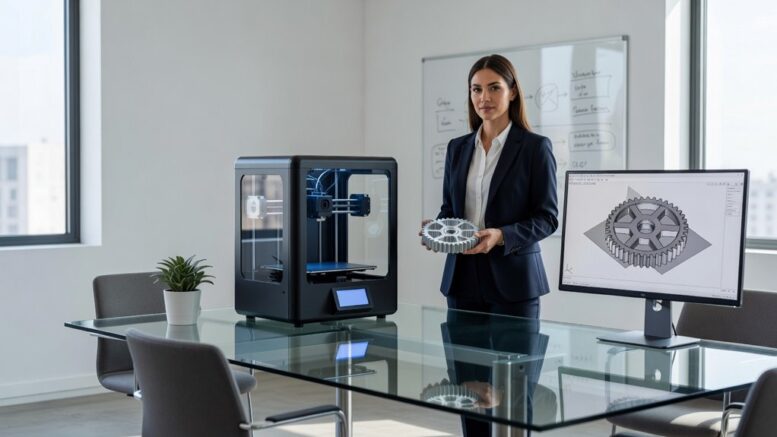
I’ve found five office‑ready printers that keep things fast and simple. The Creality K2 Plus offers a 350 mm cube, dual AI cameras, and up to 16‑color switching. The Creality K2 Combo adds smart auto‑leveling, Wi‑Fi, and a built‑in air purifier. Anycubic’s Kobra S1 Combo runs at 600 mm/s, auto‑calibrates, and dries filament. Geeetech’s Smart Mini is fully assembled, Wi‑Fi enabled, and auto‑levels with 16 points. A sturdy stand with filament racks and power strips rounds out the setup. keep on to see why these choices fit an office workflow.
| Creality K2 Plus 3D Printer with Multi‑Color High‑Speed Auto‑Leveling Dual‑Camera Direct‑Drive Large Build Volume |  |
Pro‑Performance | Build Volume: 350 × 350 × 350 mm | Print Speed: Up to 600 mm/s | Multi‑Color Capability: 4‑CFS units, up to 16 colors | GET THE LATEST DEAL | Full Insight |
| Creality K2 Combo 3D Printer with Smart Auto Leveling | 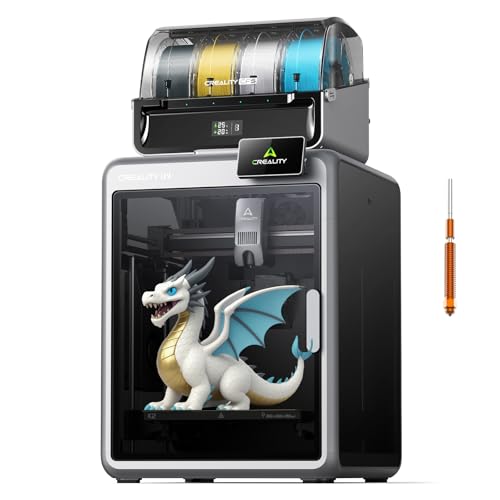 |
Smart Auto‑Level | Build Volume: 260 × 260 × 260 mm | Print Speed: Up to 600 mm/s | Multi‑Color Capability: 1‑CFS unit, expandable to 4, up to 16 colors | GET THE LATEST DEAL | Full Insight |
| Anycubic Kobra S1 Combo 3D Printer 600mm/s Auto Calibration |  |
Speed Specialist | Build Volume: Not explicitly listed (approx. 250 mm cube) | Print Speed: Up to 600 mm/s | Multi‑Color Capability: 4‑color printing out of the box, expandable to 8 | GET THE LATEST DEAL | Full Insight |
| Geeetech Smart Mini 3D Printer with WiFi and Auto‑Leveling | Beginner Friendly | Build Volume: 100 × 110 × 100 mm (3.94 × 4.33 × 3.94 in) | Print Speed: Up to 250 mm/s | Multi‑Color Capability: No multi‑color system | GET THE LATEST DEAL | Full Insight | |
| 3D Printer Stand with Filament Storage and Drawer (Black) | 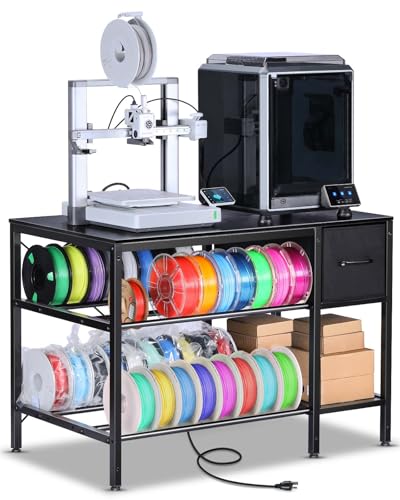 |
Workspace Organizer | Build Volume: N/A (stand only) | Print Speed: N/A | Multi‑Color Capability: N/A | GET THE LATEST DEAL | Full Insight |
More Details on Our Top Picks
-
Creality K2 Plus 3D Printer with Multi‑Color High‑Speed Auto‑Leveling Dual‑Camera Direct‑Drive Large Build Volume
If you need fast, multi‑color prints without juggling filaments, the Creality K2 Plus fits the bill. I appreciate its 4 CFS units that switch up to 16 colors automatically. The dual AI cameras watch the chamber and toolhead, fixing flow and bed tilt before each job. Its 350 mm cube build volume lets me print large parts or batches. The aluminum frame and dual Z‑axis keep the bed stable at 600 mm/s. Direct‑drive extrusion handles high‑temp filaments up to 350 °C. RFID reads filament type, so low‑stock alerts trigger a relay swap. I find it reliable for office prototypes.
- Build Volume:350 × 350 × 350 mm
- Print Speed:Up to 600 mm/s
- Multi‑Color Capability:4‑CFS units, up to 16 colors
- Auto‑Leveling:Dual Z‑axis with auto bed tilt and leveling
- Connectivity:Not specified (likely USB/SD)
- Frame Material:Aerospace‑grade aluminum alloy die‑cast
- Additional Feature:Dual AI cameras
- Additional Feature:RFID filament identification
- Additional Feature:70‑lb heavy‑duty frame
-
Creality K2 Combo 3D Printer with Smart Auto Leveling
The Creality K2 Combo is perfect for office teams that need fast, reliable 3‑D prints without hassle. I unpacked it and it was ready to go. The smart auto‑leveling guided me through calibration in minutes. Its 260 mm cube build volume fits most prototypes. The multi‑color CFS unit lets me switch up to four filaments automatically, producing vivid gradients. Direct‑drive extrusion reaches 300 °C, handling PLA, ABS, PETG, and engineering filaments. The silent mode and vibration‑free design keep the workspace calm. Wi‑Fi, 8 GB storage, and an AI camera monitor prints, while the built‑in air purifier removes VOCs.
- Build Volume:260 × 260 × 260 mm
- Print Speed:Up to 600 mm/s
- Multi‑Color Capability:1‑CFS unit, expandable to 4, up to 16 colors
- Auto‑Leveling:Smart Auto Leveling with guided calibration
- Connectivity:Wi‑Fi, 8 GB local storage
- Frame Material:Aerospace‑grade aluminum
- Additional Feature:Built‑in air purifier
- Additional Feature:Wi‑Fi connectivity
- Additional Feature:8 GB local storage
-
Anycubic Kobra S1 Combo 3D Printer 600mm/s Auto Calibration
Need fast, reliable multi‑color prints for a busy office? I tried the Anycubic Kobra S1 Combo. Its Core XY design feels solid, and the sealed chamber keeps prints clean. It reaches 600 mm/s with 20,000 mm/s² acceleration, so I finish parts in minutes. The auto‑calibration saves me time, and the built‑in dryer keeps filament dry 24/7, preventing jams. It handles four colors out of the box, and pairing two units gives eight‑color capability. The app lets me start and monitor jobs remotely. Overall, it delivers speed and precision without extra accessories.
- Build Volume:Not explicitly listed (approx. 250 mm cube)
- Print Speed:Up to 600 mm/s
- Multi‑Color Capability:4‑color printing out of the box, expandable to 8
- Auto‑Leveling:Auto calibration (bed leveling)
- Connectivity:Anycubic app (Wi‑Fi/remote)
- Frame Material:Core XY aluminum frame
- Additional Feature:Integrated filament dryer
- Additional Feature:Flow correction technology
- Additional Feature:Remote app control
-
Geeetech Smart Mini 3D Printer with WiFi and Auto‑Leveling
Got a small office that needs quick, reliable prototypes? I tried the Geeetech Smart Mini. It arrived fully assembled, so I could start printing right away. The 2.4″ LCD shows status clearly, and the Wi‑Fi app lets me control jobs from my laptop. Auto‑leveling uses 16 points, which saved me time and gave consistent first layers. The heated magnetic plate removes warps and makes part removal easy. Direct‑drive extruder handles PLA and TPU up to 0.5 kg without slipping. Its 250 mm/s speed feels fast for a 3.94‑inch cube. Warranty covers 30 days returns, a year of free repairs, and lifetime tech support.
- Build Volume:100 × 110 × 100 mm (3.94 × 4.33 × 3.94 in)
- Print Speed:Up to 250 mm/s
- Multi‑Color Capability:No multi‑color system
- Auto‑Leveling:16‑point full‑auto leveling
- Connectivity:Wi‑Fi, app control
- Frame Material:Metal (unspecified alloy)
- Additional Feature:16‑point auto‑leveling
- Additional Feature:Magnetic removable plate
- Additional Feature:2.4″ LCD screen
-
3D Printer Stand with Filament Storage and Drawer (Black)
If you need a sturdy spot for your 3D printer and quick access to filaments, this black stand fits the bill. I’ve placed my printer on its spacious tabletop and it stays level. The metal frame feels solid, and the 37‑pound weight keeps it from wobbling. Two built‑in filament racks hold spools on middle and bottom shelves, while fabric drawers store tools and accessories. The power strip offers two AC outlets and two USB ports, and the 140 cm cord lets me position it anywhere. Its compact size (39.4″ × 23.7″ × 28.4″) works well in a home office or workshop.
- Build Volume:N/A (stand only)
- Print Speed:N/A
- Multi‑Color Capability:N/A
- Auto‑Leveling:N/A
- Connectivity:N/A
- Frame Material:Metal frame (steel)
- Additional Feature:Built‑in power strip
- Additional Feature:Dual‑level filament racks
- Additional Feature:Fabric storage drawers
Factors to Consider When Choosing a 3D Printer for Office
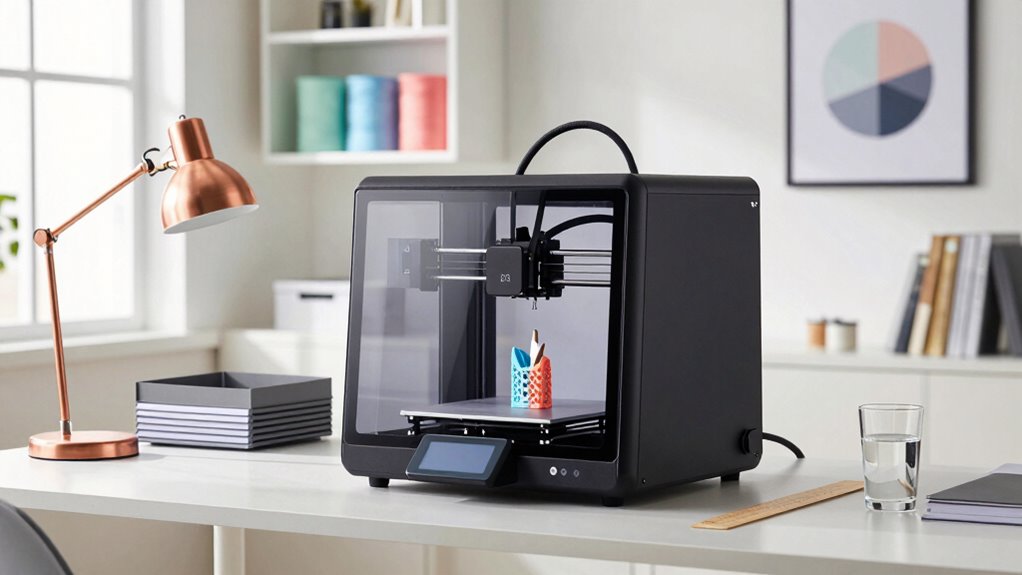
I look at print volume first, because I need to fit the parts I’m making. I also check material compatibility and speed, so the printer can handle the filaments I use and finish jobs quickly. Finally, I consider automation, monitoring, and footprint to make sure it fits into my office workflow without taking up too much space.
Print Print Volume
Print volume sets the biggest size you can make in one go, so it decides whether you’ll need to split a design or can print it whole. I look at the maximum dimensions the printer can handle. If it fits my largest part, I avoid cutting models into pieces. Bigger build volumes let me print whole prototypes or assemblies, which cuts down on post‑print assembly. In an office, a mid‑size volume often fits better on a desk and takes up less floor space. I also watch the warm‑up time; larger chambers can delay daily throughput. When I compare printers, I ask how big my typical parts are, whether I need batch runs, and if I can print several small items at once in the same build area.
Material Compatibility Range
What materials can you actually use with a printer? I look at PLA, PETG, ABS, and engineering grades. If you need high‑temp filaments, you’ll want a nozzle that reaches 300 °C plus and a heated chamber to stop warping. A direct‑drive extruder helps with flexible TPU and those high‑temperature plastics because it pushes filament precisely. Some printers offer dual extrusion or multiple filament channels, letting you combine composites or soluble supports in one job. Keep filaments dry; moisture ruins hygroscopic materials, especially the tougher engineering ones. I check for airtight storage and desiccants built into the printer. Choosing a machine with these features expands what you can print and keeps results reliable.
Speed and Throughput
How fast can a printer keep up with office demands? I look at mm/s first. Higher numbers mean quicker prototypes, but they only help if the printer can maintain flow without losing adhesion. Acceleration matters too; 20,000 mm/s² cuts start‑stop time, so complex parts finish faster. I watch peak speed, like 600 mm/s, but I balance it against layer quality; too fast can cause gaps and reprints. Consistent layers and reliable auto‑leveling keep failures low, boosting real throughput. If I need multiple colors or materials, frequent filament swaps add time, so I prefer printers that handle multi‑material runs without constant changes. In short, I match speed specs to my office’s need for speed versus quality.
Automation and Monitoring Features
Ever wonder if a printer can take care of itself? I’ve seen models that auto‑level the bed before each job, so I never waste time tweaking knobs. The AI camera watches the print, catching a jam or layer shift the moment it happens. If the filament runs out, the machine swaps it automatically, reading RFID tags to pick the right color or material. Sensors monitor chamber temperature, airflow, and VOCs, keeping the air clean and the part quality consistent. I can start a job from my laptop and let the printer handle the rest, even when I’m away. All these features cut down on manual checks and let me focus on design instead of maintenance.
Footprint and Workspace Integration
A compact printer fits on a desk without blocking other gear, and it saves me from rearranging the whole office. I look for a slim profile that tucks into a corner or a small workstation. Integrated cable management and built‑in power reduce clutter and keep cords safe in a busy environment. A stable, vibration‑damping frame and an enclosed or low‑noise enclosure prevent distractions for coworkers. I also check idle features: auto‑off or low‑power standby keep the footprint tiny when the machine isn’t printing. Finally, I match the build volume to the size of typical office prototypes, so I don’t waste space or end up with a printer that’s too big for the room. This way the printer fits smoothly into my workflow.
Be the first to comment on "5 Top-Rated 3D Printers That Will Transform Your Office Workflow"